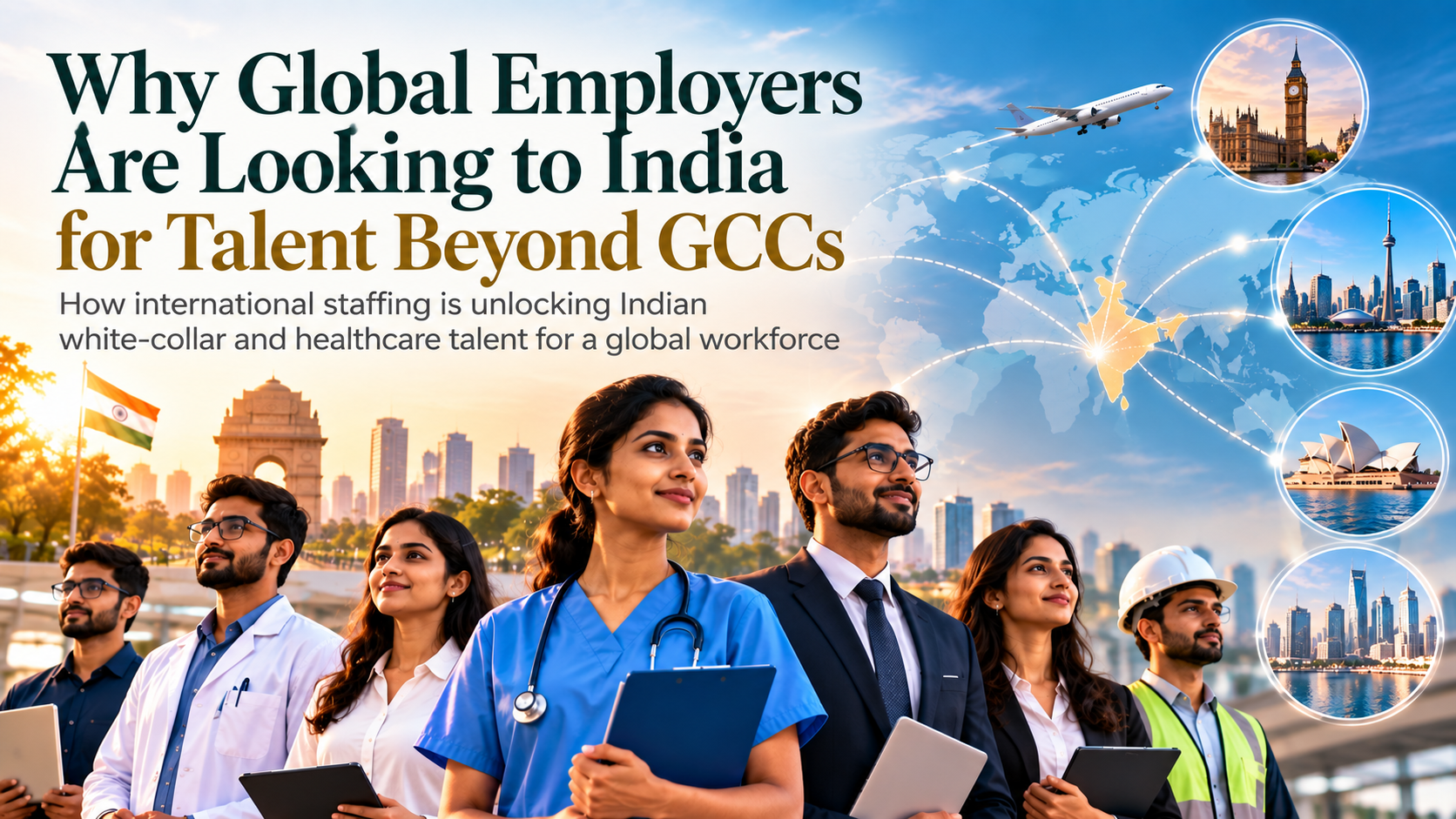
India is moving toward a more structured model of international talent mobility. A 2026 NITI Aayog framework calls for states to build safe, demand-responsive systems that connect Indian workers with labour-market opportunities overseas, while the government has identified priority countries, sectors and roles facing shortages. For global employers, this could make India increasingly important not simply as a source of migrants, but as a structured source of internationally deployable talent.
Key Takeaways
- India is beginning to treat international talent mobility as a workforce and economic strategy rather than simply an outcome of migration.
- NITI Aayog's 2026 framework calls for states to develop structured international mobility ecosystems.
- The framework identifies substantial labour shortages across Europe, the United States and the GCC.
- India already has an overseas migrant population of approximately 18.5 million.
- The opportunity extends beyond traditional migration into technology, engineering, healthcare, manufacturing, finance and other specialist professions.
- Nurses and healthcare professionals require a specialised international staffing model because qualification and licensing requirements vary by destination.
- Global employers increasingly need access to talent pipelines rather than individual candidates.
- India's competitive advantage could increasingly come from the infrastructure connecting its talent to international demand.
The Biggest Change in India's Talent Story Is Happening Quietly
India's global workforce story has traditionally been described in relatively simple terms.
Indian professionals migrate.
Indian workers move to the Gulf.
Indian engineers join technology companies abroad.
Indian nurses move into international healthcare systems.
Indian students become international professionals.
But the underlying system has historically been fragmented.
Candidates search for opportunities.
Recruiters search for vacancies.
Governments manage migration.
Employers manage hiring.
Training institutions develop skills.
Professional bodies handle qualifications.
Immigration authorities handle visas.
Each part of the system operates with its own priorities.
That is beginning to change.
In May 2026, NITI Aayog published its "States' Framework: Advancing International Mobility for Skilled Workers."
The significance of the document is not simply that it discusses migration.
It explicitly positions states as central actors in building structured, safe and demand-responsive international mobility ecosystems.
That is a much bigger idea.
India Is Starting to Think of Talent Mobility as Infrastructure
The NITI Aayog framework argues that India's international mobility potential should be supported by stronger institutional mechanisms.
Its logic is straightforward.
India has a large and relatively young workforce.
Other economies have labour shortages.
The missing piece is a better mechanism for matching the two.
According to the framework, nearly 65% of India's population is below 35, while the working-age population is projected to reach approximately 65.05% of the population by 2030.
At the same time, NITI Aayog cites labour shortages of approximately:
- 10.5 million in Europe
- 7.2 million in the United States
- 2.7 million in the GCC region
These figures should not be interpreted as a promise that India can fill every vacancy.
They demonstrate something more important:
The global demand side is large enough to justify building dedicated talent-mobility infrastructure.
This Changes the Role of Indian Staffing Companies
Historically, an Indian recruitment company might have started with:
"We have candidates."
A global employer might have started with:
"We have vacancies."
The international staffing opportunity sits between these two statements.
The question becomes:
Can we systematically match international demand with verified Indian capability?
That requires significantly more than CV sourcing.
It requires:
- Market intelligence
- Occupation mapping
- Candidate identification
- Skills assessment
- Qualification verification
- Language assessment
- Employer matching
- Immigration coordination
- Professional licensing support
- Relocation preparation
- Post-placement support
The staffing company begins to look less like a recruiter.
It starts to look like a talent-mobility operator.
The Global Employer's Problem Is Changing
Consider a European healthcare group.
It may know that it needs 100 nurses.
The traditional recruitment approach would be:
Advertise → Receive applications → Interview → Hire.
International recruitment looks different.
The employer may need:
Demand Forecasting
How many nurses will be needed over the next 12–24 months?
↓
Source-Market Analysis
Which countries have the relevant talent pool?
↓
Candidate Pipeline
Which professionals are potentially suitable?
↓
Credential Verification
Are their qualifications genuine and relevant?
↓
Professional Recognition
Can they obtain the necessary registration?
↓
Language Readiness
Do they meet destination-country requirements?
↓
Immigration
Can they legally enter and work?
↓
Relocation
Can they move successfully?
↓
Retention
Will they remain with the employer?
The vacancy is only the beginning.
White-Collar Staffing Has the Same Structural Problem
The same principle applies to international white-collar hiring.
A technology company may need:
- AI engineers
- Software developers
- Cloud specialists
- Cybersecurity professionals
- Data scientists
- Product managers
- Engineering managers
An engineering company may need:
- Mechanical engineers
- Electrical engineers
- Project engineers
- Manufacturing specialists
- Automation professionals
A logistics company may need:
- Supply-chain specialists
- Procurement professionals
- Operations managers
- Planning specialists
The challenge is not whether India has professionals in these categories.
It does.
The challenge is whether those professionals can be efficiently identified, assessed and matched with a specific international employer and role.
That is a very different problem from conventional recruitment.
Healthcare Makes the Opportunity Even More Obvious
Healthcare provides perhaps the clearest example of why international staffing requires infrastructure.
A hospital cannot simply say:
"We need nurses. Find us 100."
The staffing partner needs to understand:
- Nursing qualifications
- Clinical experience
- Professional registration
- Destination-country recognition
- Language requirements
- Credential verification
- Immigration requirements
- Employer requirements
- Relocation
- Candidate expectations
The WHO strengthened its Global Code of Practice on the International Recruitment of Health Personnel in 2026, including provisions concerning internationally recruited care workers and encouraging co-investment in health systems so that international recruitment benefits both source and destination countries.
This matters because international healthcare recruitment cannot be built purely around volume.
It has to be built around responsible mobility.
India Already Has the Scale
India does not need to prove that its people can work internationally.
The migration numbers already demonstrate that.
NITI Aayog's framework cites an overseas migrant population of approximately 18.5 million.
India is also the world's largest recipient of remittances, with approximately $137.67 billion received in 2024 according to the World Bank figures cited by NITI Aayog.
This is a huge existing international workforce network.
But there is a difference between having millions of people overseas and having a sophisticated talent-mobility system.
The next stage is about building the system.
From Migration to Talent Mobility
There is an important conceptual difference between the two.
Migration
People move from one country to another.
Talent Mobility
Specific skills are deliberately connected with specific international demand.
The second model is more strategic.
Instead of asking:
"Which Indians want to move abroad?"
the question becomes:
"Which international employers need capabilities that India can supply?"
That shift puts the employer at the centre of the system.
And that is exactly where international staffing becomes commercially interesting.
The 25-Country Opportunity
India's Ministry of Skill Development and Entrepreneurship said in July 2026 that the Ministry of External Affairs had shared information on 25 priority countries, including sectors and job roles in those countries facing labour shortages.
MSDE is also working on aligning Indian skill-development programmes with country-specific overseas labour-market requirements.
This is significant.
It suggests that international mobility is moving toward a more targeted model:
Country → Sector → Occupation → Skill → Candidate
rather than simply:
Country → Worker
For staffing companies, this is a much more powerful framework.
The Future Staffing Database Will Look Different
A conventional recruitment database might contain:
- Name
- Experience
- Education
- Contact information
- Current employer
An international staffing database needs much more.
It could include:
| Dimension | Example |
|---|---|
| Profession | Registered Nurse |
| Specialisation | ICU |
| Experience | 7 years |
| Qualification | BSc Nursing |
| Registration | Active |
| Language | English |
| Destination eligibility | Under assessment |
| Preferred markets | UK / Germany / Italy |
| Relocation readiness | High |
| Notice period | 60 days |
| Compensation expectation | Destination-specific |
| Documentation | Verified / Pending |
| Mobility stage | Employer-ready |
The difference is important.
The database is no longer simply a list of people.
It becomes a map of internationally deployable capability.
This Is Where AI Could Become Useful
International staffing generates enormous amounts of structured information.
AI can potentially help staffing companies identify patterns across:
- Job descriptions
- Candidate profiles
- Qualifications
- Skills
- Compensation
- Destination requirements
- Visa pathways
- Professional licensing
- Employer demand
Imagine an employer in Germany looking for 50 mechanical engineers.
Instead of manually searching thousands of CVs, a staffing platform could identify candidates based on:
Role requirements + technical skills + experience + qualification + language + mobility readiness + destination eligibility.
The output is not simply:
"Here are 500 candidates."
It becomes:
"Here are 74 candidates who appear to meet the employer's technical requirements and are at different stages of international readiness."
That is a much more valuable staffing product.
The Bottleneck Will Move From Talent Supply to Talent Readiness
This may become one of the most important developments in international staffing.
India has enormous talent supply.
But not every professional is immediately internationally deployable.
A candidate may have the right skills but lack:
- Language proficiency
- Credential recognition
- Professional registration
- Documentation
- International interview readiness
- Immigration eligibility
- Relocation preparedness
Therefore, the next competitive advantage may not be access to candidates.
It may be access to ready candidates.
That creates an opportunity for staffing companies to build talent pipelines months before employers formally open vacancies.
Why Employers Should Start Earlier
International staffing has a longer lead time than domestic recruitment.
If a European employer needs 50 nurses next quarter, beginning the search next quarter may already be too late.
The employer should instead think in terms of a talent pipeline.
For example:
12 months before demand
Market mapping.
9 months before demand
Candidate identification.
6 months before demand
Assessment and verification.
3–6 months before demand
Employer interviews and documentation.
Joining period
Immigration and relocation.
This transforms recruitment from a reactive process into workforce planning.
The Opportunity for Indian States
NITI Aayog's framework places significant emphasis on states.
That makes sense.
International mobility is not created in New Delhi alone.
A candidate's journey can involve:
- State-level skilling
- Training institutions
- Universities
- Professional bodies
- Recruitment companies
- Employers
- Immigration authorities
- Overseas governments
States can therefore potentially develop specialised talent corridors.
For example:
Kerala → Healthcare → Europe
Telangana → Technology → Global Markets
Tamil Nadu → Engineering → Manufacturing
Karnataka → Technology → International Employers
These are illustrative examples rather than predictions.
The larger idea is that states can align local talent development with actual international demand.
The Staffing Opportunity Is Bigger Than Recruitment
If international mobility becomes more organised, a new ecosystem can emerge around it.
Potential participants include:
- Universities
- Skill-development organisations
- Professional certification bodies
- Recruitment companies
- Immigration specialists
- Employers
- Governments
- Relocation providers
- Training companies
- Technology platforms
The staffing company can sit at the centre of many of these relationships.
Its role becomes:
Demand intelligence + talent access + verification + mobility execution.
That is a much larger proposition than recruitment alone.
There Is Also a Risk
India should not approach international mobility simply as a numbers game.
Sending more people abroad is not automatically a success.
A sustainable system must consider:
- Candidate protection
- Ethical recruitment
- Qualification integrity
- Worker rights
- Destination-country requirements
- Source-country workforce needs
- Long-term career outcomes
The WHO's 2026 amendment to its international recruitment code reinforces this principle for healthcare.
International recruitment should create value for both sides.
What Global Employers Should Take From This
The important question for an international employer is no longer:
"Can I recruit from India?"
The answer is clearly yes.
The more useful question is:
"How mature is my India talent pipeline?"
An employer should know:
- Which Indian talent pools are relevant?
- Which occupations can be recruited internationally?
- What qualifications are required?
- What verification is necessary?
- What immigration route applies?
- What preparation do candidates need?
- What is the realistic time-to-hire?
- What will make the employee stay?
The organisations that answer these questions before a talent shortage becomes critical will have an advantage.
What This Means for Terracruit
For Terracruit, India's evolving international mobility architecture points toward a larger opportunity.
The business is not simply about finding Indian candidates.
It is about building connections between:
Global employer demand
and
Indian professional capability.
That means understanding both markets simultaneously.
A global employer may say:
"We need 30 nurses."
Terracruit needs to understand what those 30 nurses actually need to look like.
A technology company may say:
"We need 20 engineers."
Terracruit needs to understand the technical requirements, destination constraints and candidate-readiness criteria.
That is the difference between recruitment and international staffing.
The Bigger Picture
India has spent decades becoming one of the world's largest sources of internationally mobile professionals.
The next stage is more sophisticated.
It is about building systems that deliberately connect:
Global labour demand
with
Indian talent supply.
NITI Aayog's international mobility framework is an important signal because it treats this as an ecosystem rather than simply a migration outcome.
For global employers, that means India should increasingly be considered not only as a location for outsourcing or GCCs.
It should also be considered as a strategic source market for international talent.
For Indian professionals, it means international careers can become more structured and accessible.
And for staffing companies, it creates a new category:
Talent mobility infrastructure.
Frequently Asked Questions
What is India's international talent mobility strategy?
India is increasingly developing systems to connect its workforce with international labour-market demand. NITI Aayog's 2026 framework calls for states to build structured, safe and demand-responsive international mobility ecosystems.
How large is India's overseas workforce?
NITI Aayog's 2026 framework cites an overseas migrant population of approximately 18.5 million.
Which countries need Indian talent?
Demand varies by occupation and country. NITI Aayog identifies significant labour shortages across Europe, the United States and the GCC and the Government of India has identified 25 priority countries for international mobility planning.
Which Indian professionals can be recruited internationally?
Depending on destination-country requirements, opportunities can exist across technology, engineering, healthcare, manufacturing, finance, logistics, hospitality and other specialist occupations.
Why are nurses important to international staffing?
Many countries face healthcare workforce shortages. However, nursing is a regulated profession, meaning qualification recognition, professional registration, language and immigration requirements must be addressed before successful placement.
What is the difference between recruitment and international staffing?
Recruitment focuses primarily on finding candidates for vacancies. International staffing involves a broader process that can include sourcing, verification, qualification recognition, employer matching, immigration, relocation and retention.
Why is candidate verification important?
International employers may need to assess qualifications, employment history, professional registrations and other credentials across jurisdictions. Verification reduces the risk of mismatches and fraudulent documentation.
What is talent mobility infrastructure?
Talent mobility infrastructure is the combination of institutions, processes, technology and services that connect workers with international employment opportunities. It can include training, credential verification, recruitment, immigration and relocation.
Why should global employers recruit from India?
India offers large talent pools across technology, engineering, healthcare and other specialist professions, alongside an established international migration ecosystem.
Is international recruitment ethical?
It can be when it is transparent, compliant and protects worker rights. Healthcare recruitment requires particular attention to ethical international recruitment principles because aggressive recruitment can affect source-country health systems.
Final Thoughts
India's international staffing opportunity is entering a different phase.
The country no longer needs to prove that its professionals can work internationally.
Millions already do.
The bigger challenge is building the infrastructure that makes international talent mobility more predictable, transparent and scalable.
That means moving from:
Candidate sourcing
to
Talent pipelines.
From:
Migration
to
Talent mobility.
From:
Recruitment
to
Workforce infrastructure.
For global employers facing persistent talent shortages, this distinction matters.
India is not simply a large labour market.
It could become one of the world's most important talent supply ecosystems.
The companies that build the connections between the two sides will be the ones that capture the opportunity.
About Terracruit
Terracruit is an international staffing company connecting global employers with qualified Indian talent.
The company focuses on white-collar professionals and healthcare talent, including nurses, for international employment opportunities.
Terracruit helps employers access Indian talent while navigating the verification, qualification, mobility and cross-border hiring requirements involved in international staffing.
Sources
- NITI Aayog — States' Framework: Advancing International Mobility for Skilled Workers, 2026
- Government of India, Ministry of Skill Development and Entrepreneurship — International Mobility of Skilled Workers, July 2026
- World Bank — Remittances
- World Health Organization — Global Code of Practice on the International Recruitment of Health Personnel, amended 2026
- OECD — International Migration and Labour-Market Data
Internal Linking Suggestions
- Link “international staffing” to Terracruit's international staffing service page.
- Link “Indian talent” to the Terracruit India talent page.
- Link “white-collar professionals” to the white-collar staffing page.
- Link “healthcare talent” to the healthcare staffing page.
- Link “nurses” to the international nurse recruitment page.
- Create a pillar page titled “Hiring Indian Talent Internationally”.
- Create supporting articles for “How Global Companies Can Hire Engineers From India”.
- Create “How to Hire Indian Nurses for International Hospitals”.
- Create “India Talent Mobility: Country-by-Country Hiring Guide”.
- Create destination-specific clusters for Germany, Italy, UK, Australia, UAE and Japan.
Planning your career abroad?
Terracruit walks you through every step — persona mapping, CV and LOR reviews, outreach and interview preparation — so you are never figuring it out alone. Start with our free tools and see where you stand.
Or talk to us: Contact Terracruit