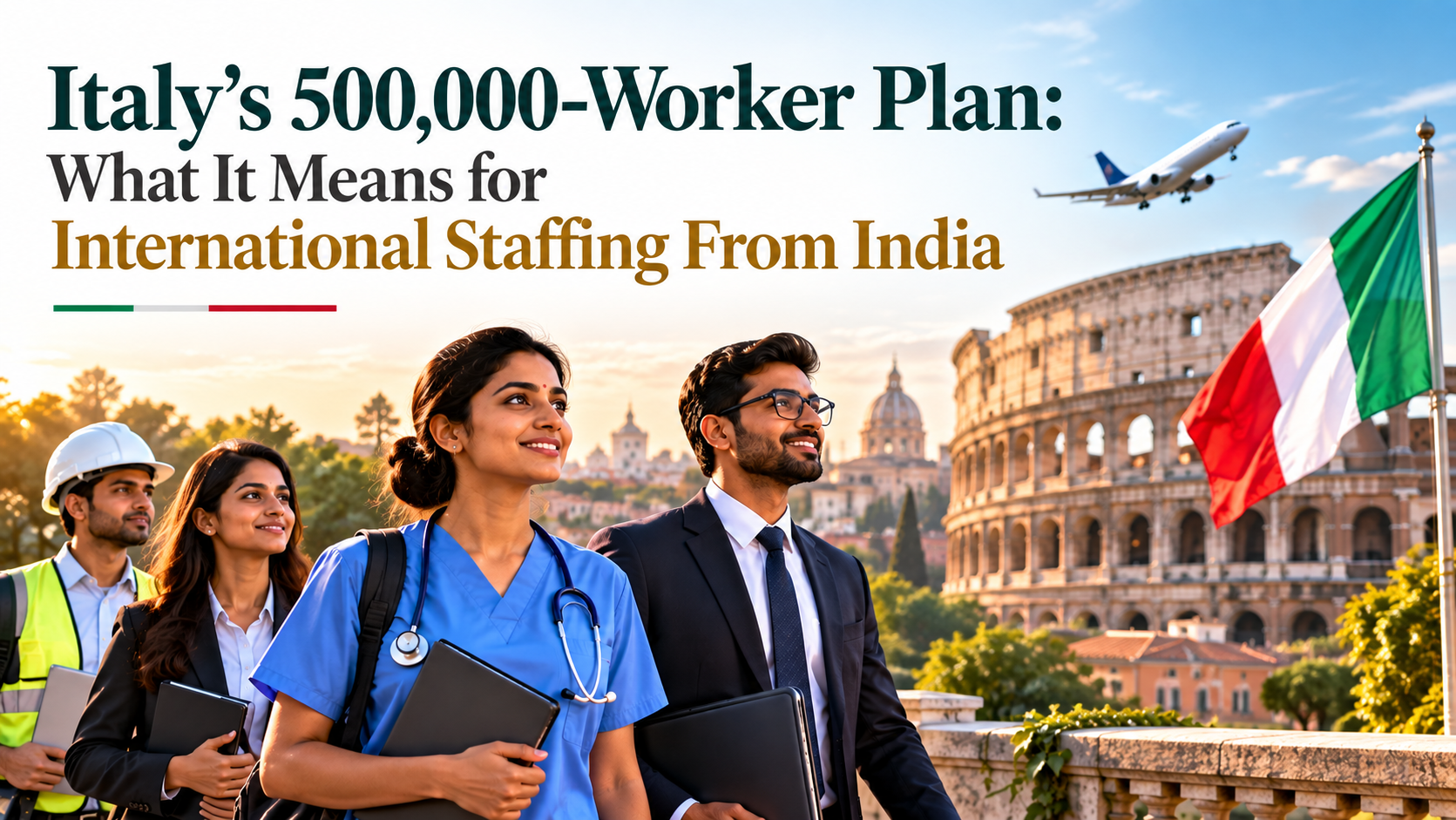
Italy’s 2026–2028 labour migration programme provides for 497,550 legal entries for non-EU workers, including 230,550 non-seasonal and self-employed workers and 267,000 seasonal workers. For international staffing companies sourcing from India, this creates a significant opportunity—but the real challenge will be converting immigration capacity into qualified, compliant and job-ready placements.
Key Takeaways
- Italy has planned almost 500,000 legal worker entries between 2026 and 2028.
- The programme is designed partly to address labour shortages that cannot be filled domestically.
- 230,550 places are allocated to non-seasonal subordinate and self-employed work.
- 267,000 places are allocated to seasonal agricultural and tourism work.
- India is already an important source country for international workers and has established migration networks across Europe.
- Visa availability does not eliminate recruitment challenges.
- Candidate verification, documentation, employer sponsorship and regulatory compliance remain critical.
- Healthcare and skilled professional recruitment require significantly more preparation than simply matching a CV to a vacancy.
- For international staffing companies, the opportunity lies in building reliable talent pipelines before employers need them.
Italy Has Opened a Significant New Labour-Mobility Channel
Italy is facing a workforce problem familiar to many developed economies.
An ageing population, changing demographics and persistent labour shortages are creating pressure across parts of the economy.
The response is increasingly becoming structured labour migration.
Italy's government has approved a programme covering the 2026–2028 period that provides for 497,550 legal entries of non-EU workers.
The programme includes:
- 230,550 non-seasonal and self-employed workers
- 267,000 seasonal workers
The stated objective is to allow businesses to access labour that cannot be adequately sourced within Italy while creating a more predictable and controlled framework for legal migration.
That distinction matters.
This is not simply an immigration story.
It is a labour-market story.
Why This Matters to International Staffing
A large immigration quota creates the possibility of recruitment.
It does not create the recruitment pipeline itself.
That is the important distinction for employers.
A company may have an approved position.
Italy may have available immigration capacity.
But the employer still needs a candidate who is:
- Qualified
- Experienced
- Verified
- Available
- Suitable for the role
- Prepared for relocation
- Eligible under the relevant immigration pathway
And the candidate needs an employer that is actually ready to complete the process.
This creates a gap between:
Visa capacity
and
Actual workforce placement
That gap is where professional international staffing becomes valuable.
Italy's Programme Is About More Than Seasonal Labour
The headline figure of almost 500,000 entries is impressive.
But it is important to separate the categories.
The programme includes a substantial allocation for seasonal workers, particularly in agriculture and tourism.
There is also a sizeable non-seasonal component.
For international staffing companies, the non-seasonal component is particularly interesting because it creates opportunities to build longer-term talent pipelines rather than simply filling temporary labour requirements.
The strategic question is therefore:
Which occupations will Italian employers struggle to fill domestically, and which of those can realistically be sourced from India?
That is a much more useful question than simply asking how many visas are available.
India Has a Natural Role in the Conversation
India already has one of the world's largest overseas migrant populations.
A July 2026 Government of India update cited India's overseas migrant population at approximately 18.5 million and noted that the government has identified 25 priority countries along with sectors and roles facing labour shortages.
The government is also developing systems to better align Indian skilling with international labour-market requirements.
This is important because international recruitment works best when three things exist simultaneously:
Demand in the destination country
Talent supply in the source country
A functioning mobility pathway
Italy increasingly has the first.
India has the second.
The opportunity is to build the third.
But a Visa Quota Is Not a Hiring Strategy
This is where many international recruitment programmes become overly optimistic.
A country can announce hundreds of thousands of work-entry opportunities.
That does not mean hundreds of thousands of suitable candidates will automatically appear.
The employer still has to answer:
What role are we hiring for?
The job must be clearly defined.
What qualifications are required?
The candidate must meet the actual requirements rather than simply appear relevant on paper.
What documentation is necessary?
Educational credentials, employment records, identity documents and other supporting materials may need verification.
Does the candidate meet Italian requirements?
Different occupations can involve different professional and regulatory requirements.
Who initiates the immigration process?
The employer's role is critical in Italy's regulated labour-entry system.
How long will the process take?
International recruitment involves more steps than a domestic hire.
What happens after arrival?
Relocation and onboarding can determine whether the hire becomes a successful long-term placement.
The staffing process therefore needs to begin well before the visa application.
The Real Product Is Not the Candidate
This is an important shift in how international staffing should be understood.
A candidate database is not the product.
A successful placement is the product.
And successful placement requires a chain of activities.
Talent Mapping
↓
Candidate Screening
↓
Qualification Verification
↓
Employer Matching
↓
Documentation
↓
Employment Offer
↓
Immigration Process
↓
Relocation
↓
Onboarding
↓
Retention
A weakness at any stage can cause the entire process to fail.
That is why international staffing requires more operational depth than conventional recruitment.
Where Indian White-Collar Talent Could Fit
Italy's labour requirements should not be viewed exclusively through the lens of low-skilled or seasonal recruitment.
India can potentially provide international employers with a much broader talent pool.
Depending on employer demand and regulatory requirements, relevant categories could include:
- Engineers
- IT professionals
- Software developers
- Data specialists
- Finance professionals
- Supply-chain specialists
- Project managers
- Technical specialists
- Manufacturing professionals
- Healthcare professionals
The important consideration is not whether an occupation exists in India.
It is whether the combination of:
Skill + qualification + experience + language + mobility eligibility
matches Italian employer demand.
Healthcare Requires a Different Recruitment Model
Healthcare deserves separate attention because the barriers are substantially higher.
A nurse cannot simply be recruited because an employer has a vacancy.
Professional qualifications need to be assessed.
Registration and licensing requirements need to be understood.
Language requirements may apply.
Documentation must be accurate.
Immigration requirements must be satisfied.
The candidate also needs to understand what practising as a healthcare professional in Italy actually involves.
This is precisely why healthcare international staffing should be treated as a specialised function rather than generic recruitment.
The Broader European Signal
Italy is not operating in isolation.
Across Europe, demographic change is creating pressure on labour markets.
The OECD reports that international recruitment of healthcare professionals has increased substantially over the past decade.
In 2023, OECD countries had more than 800,000 foreign-trained nurses, up sharply from 2010.
The United States, United Kingdom and Germany alone accounted for more than 60% of foreign-trained nurses working across OECD countries.
India is already one of the major source countries for internationally mobile nurses.
This demonstrates that international recruitment is not a temporary workaround.
For many developed economies, it is becoming an established component of workforce planning.
Why India Is Particularly Interesting for Staffing Companies
India's advantage is not simply population.
It is the combination of scale and professional diversity.
The country produces large numbers of graduates and has established talent pools across:
- Technology
- Engineering
- Healthcare
- Finance
- Operations
- Manufacturing
- Logistics
- Professional services
India also has decades of experience with international employment.
Millions of Indians already work abroad.
That creates familiarity with international mobility, overseas employment and cross-cultural workplaces.
But the next opportunity is to make that process more systematic.
The Opportunity Is Not “Send Workers Abroad”
That framing is too simplistic.
The stronger model is:
Map international demand.
Then:
Identify the Indian talent capable of meeting it.
Then:
Verify the talent.
Then:
Prepare the candidate for the destination market.
Then:
Connect the candidate with a legitimate employer.
Then:
Manage the mobility process responsibly.
That is a fundamentally different proposition from simply placing job advertisements and collecting CVs.
What Italian Employers Should Do Now
Companies considering international recruitment should not wait until a vacancy becomes urgent.
They should begin with workforce planning.
1. Identify recurring shortages
Which roles repeatedly remain vacant?
2. Separate regulated from non-regulated roles
Healthcare and other regulated professions require additional planning.
3. Build destination-specific job specifications
The same job title can have different qualification and experience requirements across countries.
4. Define the candidate profile precisely
Experience, education, language, technical skills and mobility requirements should be established before sourcing begins.
5. Build a verified talent pipeline
Do not wait for the employer to need 20 candidates before beginning candidate identification.
6. Understand the immigration process
The employer should understand its responsibilities before making an offer.
7. Plan retention
The objective should not simply be arrival in Italy.
It should be successful employment.
What Indian Staffing Companies Need to Change
The Italian opportunity also creates a test for staffing companies in India.
The old model was largely:
Vacancy → CV → Interview → Placement
International staffing requires:
Market Intelligence → Talent Mapping → Verification → Compliance → Mobility → Placement → Retention
This means staffing companies need destination-country expertise.
They need to understand not just Indian candidates, but the employer, occupation and regulatory environment on the other side.
That is where specialist international staffing can create significantly more value than general recruitment.
The Ethical Dimension
International recruitment must also be handled responsibly.
A large migration quota can create incentives for intermediaries to prioritise volume over candidate welfare.
That is particularly concerning in healthcare.
The WHO Global Code of Practice on the International Recruitment of Health Personnel was designed to encourage ethical recruitment and protect both migrant health workers and health systems in countries of origin.
The OECD has also highlighted the risks of recruiting health professionals from countries facing significant workforce pressures.
A sustainable staffing model therefore needs to protect:
- Candidates
- Employers
- Source-country workforce systems
- Destination-country employers
- Patients, where healthcare workers are involved
International mobility works best when it creates a genuine employment relationship rather than simply moving people across borders.
What Italy's Programme Really Signals
The most important message from Italy may not be the number 497,550.
It is the direction of policy.
Italy is attempting to create a more structured mechanism for bringing foreign workers into the country to meet genuine labour demand.
That means employers can increasingly think about international recruitment as part of workforce strategy rather than an emergency response.
For staffing companies, that changes the opportunity.
The question is no longer:
“Can we find someone for this vacancy?”
It becomes:
“Can we build a reliable pipeline of Indian talent for this market?”
That is a much larger business.
The Emerging International Staffing Model
The future model will increasingly look like this:
Destination-country demand
↓
Occupation-level intelligence
↓
Source-country talent mapping
↓
Candidate verification
↓
Credential and regulatory assessment
↓
Employer matching
↓
Immigration
↓
Relocation
↓
Retention
The recruitment agency sits somewhere inside this chain.
The international staffing partner manages the chain.
That distinction is likely to become increasingly important.
What This Means for Terracruit
For Terracruit, developments such as Italy's expanded labour-migration programme demonstrate why international staffing needs to be built around markets rather than vacancies.
The opportunity is to understand where international employers are experiencing genuine talent shortages and then build structured Indian talent pipelines around those requirements.
That can include:
- White-collar professionals
- Engineers
- Technology specialists
- Healthcare professionals
- Nurses
- Other skilled occupations where destination-country demand and Indian talent supply intersect
The objective is not simply to export candidates.
It is to create reliable connections between:
International employer demand
and
Indian professional capability.
Frequently Asked Questions
How many foreign workers will Italy allow to enter between 2026 and 2028?
Italy's programme provides for 497,550 legal entries for non-EU workers during 2026–2028.
How many of these workers are for non-seasonal employment?
The programme provides for 230,550 non-seasonal subordinate and self-employed workers, with the remainder allocated primarily to seasonal agricultural and tourism employment.
Can Indian workers benefit from Italy's labour migration programme?
Indian workers may be eligible where their occupation, employer, nationality requirements and immigration pathway fall within the applicable Italian rules. Eligibility should be assessed against the specific programme and role rather than assumed from the overall quota.
Does an Italian employer need to recruit through a staffing company?
Not necessarily. Employers can use different recruitment and employment structures depending on the role and applicable law. A specialist international staffing company can, however, help with sourcing, screening, documentation and candidate preparation.
Are nurses included in Italy's international recruitment opportunity?
Healthcare recruitment depends on the specific Italian labour, professional-registration and immigration requirements applicable to the occupation. Nurses should be treated as a regulated professional category rather than as general labour recruitment.
Why is India relevant to European international staffing?
India has a large professional workforce across technology, engineering, healthcare, finance and other specialist sectors. It is also already one of the world's major sources of international migrants and internationally mobile healthcare professionals.
Is getting a work visa the hardest part of international recruitment?
Not necessarily. The complete process can involve candidate sourcing, verification, employer matching, documentation, professional recognition, immigration, relocation and onboarding. A visa is one component of the overall process.
What should employers do before recruiting internationally?
Employers should identify persistent talent shortages, define job requirements, understand qualification and immigration requirements, establish the appropriate employment structure and build a verified candidate pipeline.
Why is candidate verification important?
International hiring involves greater distance between employer and candidate and can involve unfamiliar qualifications, institutions and employment histories. Verification reduces the risk of qualification, identity, experience and documentation problems.
Is international recruitment ethical?
It can be, provided recruitment is transparent, compliant and respectful of worker rights. Healthcare recruitment requires particular attention to international ethical-recruitment principles and workforce pressures in source countries.
Final Thoughts
Italy's nearly 500,000-worker programme is important for a simple reason.
It demonstrates that labour mobility is becoming part of workforce planning in economies where domestic labour supply cannot meet employer demand.
For Indian staffing companies, that creates an opportunity.
But the opportunity is not simply to find people willing to move.
It is to identify the right people, verify them, prepare them and connect them with legitimate international employers through compliant pathways.
That is the difference between overseas recruitment and international staffing.
The future of global hiring will not be determined only by where jobs are created.
It will also be determined by how efficiently the right talent can move to where it is needed.
For India, that creates a significant opportunity.
For international employers, it creates a much larger talent pool.
And for specialist staffing companies, it creates an entirely new role in the global workforce ecosystem.
About Terracruit
Terracruit is an international staffing company connecting global employers with qualified Indian talent.
The company focuses on white-collar professionals and healthcare talent, including nurses, for international employment opportunities.
Terracruit's role is to help employers access Indian talent while navigating the verification, qualification, mobility and cross-border hiring requirements involved in international staffing.
Sources
- Government of Italy — Ministry of Interior / Integration Portal, Flussi 2026–2028
- Government of India — Ministry of Skill Development and Entrepreneurship, International Mobility of Skilled Workers
- OECD — International Migration Outlook 2025
- OECD — Health at a Glance 2025
- World Health Organization — Global Code of Practice on the International Recruitment of Health Personnel
Internal Linking Suggestions
- Link “international staffing” to the Terracruit international staffing service page.
- Link “Indian talent” to the Terracruit India talent sourcing page.
- Link “healthcare talent” to the Terracruit healthcare recruitment page.
- Link “nurses” to a dedicated Terracruit international nurse recruitment page.
- Create a destination-country pillar page: “Hiring Indian Talent for Europe”.
- Create a supporting article: “How Italian Employers Can Hire Skilled Workers From India”.
- Create a supporting article: “Hiring Indian Nurses for Europe: Qualification and Licensing Considerations”.
- Create a supporting article: “Italy Work Visa Quotas Explained for International Employers”.
- Create a future country cluster covering Germany, Italy, Ireland, the UK, Australia and the UAE.
Planning your career abroad?
Terracruit walks you through every step — persona mapping, CV and LOR reviews, outreach and interview preparation — so you are never figuring it out alone. Start with our free tools and see where you stand.
Or talk to us: Contact Terracruit