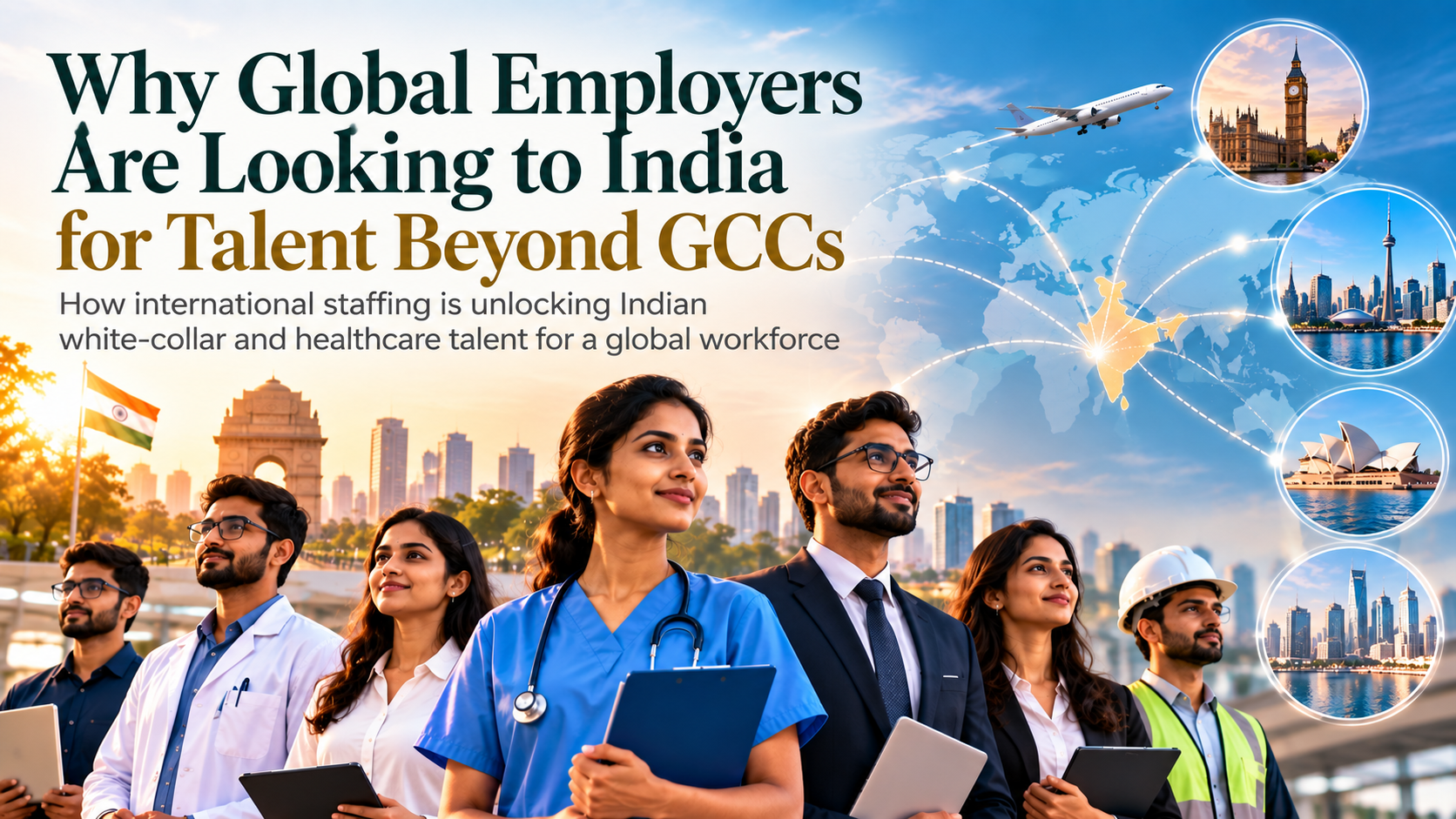
India is becoming an increasingly important source of talent for employers outside the country, and the opportunity extends well beyond Global Capability Centres. International employers are hiring Indian professionals across technology, engineering, finance, healthcare and other specialist functions, while countries facing labour shortages are increasingly using international recruitment to supplement domestic workforce supply. The challenge is converting India’s large talent pool into a reliable, compliant and job-ready international staffing pipeline.
Key Takeaways
- India is becoming a major source country for international labour and skilled migration.
- International employers do not necessarily need to establish a GCC or Indian entity to access Indian talent.
- White-collar hiring can provide companies with access to specialist skills across technology, engineering, finance, product and other functions.
- Healthcare is an especially important international staffing opportunity because many high-income countries continue to face nursing shortages.
- Nurses represent a highly regulated staffing category where qualification recognition, licensing and immigration processes are critical.
- International staffing is therefore more than candidate sourcing; it involves verification, qualification mapping, compliance and mobility.
- Ethical recruitment is essential, particularly when recruiting healthcare professionals from countries with their own workforce needs.
- The strongest staffing models combine Indian talent access with destination-country knowledge and transparent candidate processes.
India’s Global Talent Opportunity Is Bigger Than the GCC Story
India's international workforce story has often been discussed through the lens of outsourcing and Global Capability Centres.
That framing is incomplete.
A multinational company does not always need to establish an Indian office to access Indian talent.
It may need:
- Two software engineers
- A product manager
- A data scientist
- A finance specialist
- A supply-chain professional
- A senior engineering manager
- Ten registered nurses
- A cohort of healthcare professionals
- A specialist technical team
In many cases, the business problem is not:
“Should we build a GCC in India?”
It is:
“Where can we find the people we need, and how can we employ them internationally?”
That is a fundamentally different staffing question.
India's government is itself placing greater emphasis on international mobility. A July 2026 Ministry of Skill Development and Entrepreneurship update noted that India has approximately 18.5 million overseas migrants and that the Ministry of External Affairs has identified 25 priority countries along with sectors and roles facing labour shortages. :contentReference[oaicite:0]{index=0}
The government has also been developing Skill India International Centres and country-specific training initiatives designed to prepare Indian workers for overseas employment. :contentReference[oaicite:1]{index=1}
The direction is clear:
India is not only developing talent for the domestic economy.
It is increasingly developing systems for connecting Indian talent with international labour markets.
The Global Employer Has a Different Problem
For an employer in the United Kingdom, Germany, Australia, the United States or another talent-constrained market, the problem often looks very different.
The company may already know exactly what it needs.
The problem is finding enough qualified people.
Consider a healthcare provider.
It may have:
- Vacant nursing positions
- Long recruitment cycles
- Retiring employees
- Difficulties attracting domestic applicants
- Growing patient demand
A technology company may have a different set of problems:
- Shortage of experienced software engineers
- Competition for AI talent
- High local salary costs
- Difficulty finding specialised technical profiles
- Limited supply in a particular geographic market
These are different industries.
But the underlying problem is similar:
Demand for specific skills is exceeding immediately available local supply.
The OECD identifies persistent labour and skill shortages across OECD economies, particularly in areas such as healthcare and ICT. It also notes that migration can help address labour shortages when migrants' skills are effectively matched with labour-market requirements. :contentReference[oaicite:2]{index=2}
That creates a structural opportunity for international staffing.
India Is Already a Major Source of International Talent
India's role in global migration is not hypothetical.
The OECD reported that India remained the main country of origin for migration flows to OECD countries in 2023, with approximately 600,000 Indian citizens immigrating to an OECD country that year.
The United Kingdom alone received around 144,000 Indian migrants in 2023, including a significant number entering through health and care worker pathways. :contentReference[oaicite:3]{index=3}
This matters because it demonstrates something important for employers:
The international mobility infrastructure already exists.
Indian professionals are already navigating:
- International qualifications
- Immigration systems
- Professional licensing
- Relocation
- International employment
- Cross-cultural workplaces
The opportunity is to make that process more systematic.
The White-Collar Opportunity
International staffing from India is often associated with technology.
There is good reason for that.
India has a deep ecosystem of:
- Software engineers
- Data professionals
- AI specialists
- Cloud engineers
- Cybersecurity professionals
- Product managers
- Engineering managers
- Finance professionals
- Supply-chain specialists
- Business analysts
But the opportunity is broader than technology.
A global employer may be looking for a specific combination of:
Skill + experience + domain knowledge + English proficiency + international readiness
That combination can be difficult to find locally.
An international staffing model can therefore allow employers to expand the geographic boundary of their search.
Instead of competing for the same local candidate pool, an employer can access a much broader international talent market.
The Healthcare Opportunity Is Different
Healthcare staffing deserves separate consideration.
Unlike many white-collar professions, healthcare recruitment is heavily regulated.
A nurse cannot simply be recruited, given an employment contract and asked to start work in another country.
The candidate may need to satisfy requirements involving:
- Nursing education
- Professional registration
- Qualification recognition
- English-language proficiency
- Credential verification
- Professional examinations
- Immigration requirements
- Destination-country licensing
- Background checks
- Employment eligibility
This creates considerably more friction.
But that friction is precisely why specialised international staffing matters.
The Global Nursing Shortage
The scale of the healthcare workforce challenge is significant.
The WHO's State of the World's Nursing 2025 report estimates that the global nursing shortage fell from 6.2 million nurses in 2020 to 5.8 million in 2023 and projects a shortage of approximately 4.1 million by 2030.
But the global figure hides substantial regional differences.
WHO reports that approximately 78% of the world's nurses are concentrated in countries representing only 49% of the global population.
It also reports that approximately one in seven nurses worldwide is foreign-born, rising to 23% in high-income countries. :contentReference[oaicite:4]{index=4}
This tells us something important.
International nurse mobility is not a marginal phenomenon.
It is already part of how healthcare systems in many high-income countries manage workforce requirements.
India Is Already Part of the International Nursing System
The OECD's Health at a Glance 2025 report provides another important data point.
India was among the major countries of birth for nurses working in OECD countries, with approximately 120,000 India-born nurses working across OECD countries in 2020/21.
The OECD also reports that foreign-trained nurses accounted for more than 800,000 nurses working in OECD countries in 2023, up 69% from 2010. :contentReference[oaicite:5]{index=5}
This is not simply a recruitment opportunity.
It is a workforce infrastructure opportunity.
The question is how to make that infrastructure more efficient, transparent and sustainable.
The Hard Part Is Not Finding Candidates
This is where international staffing differs from conventional recruitment.
Finding an Indian professional who appears qualified is relatively easy.
Establishing that the person is genuinely ready for a particular international role is much harder.
A robust international staffing process needs to answer questions such as:
Is the qualification genuine?
Credentials need to be verified against reliable issuing institutions and appropriate professional registers.
Is the qualification recognised in the destination country?
A qualification that is valid in India may not automatically provide the right to practise in another jurisdiction.
Does the candidate meet licensing requirements?
This is particularly important in healthcare, engineering and other regulated professions.
Is the candidate immigration-ready?
Employment eligibility and visa requirements vary substantially between countries.
Is the candidate actually prepared for relocation?
A technically qualified candidate may still need preparation around:
- Workplace culture
- Language
- Professional expectations
- Cost of living
- Relocation
- Family considerations
Is the employment model compliant?
Cross-border employment can create issues involving:
- Employment law
- Payroll
- Tax
- Social security
- Permanent establishment
- Worker classification
- Employer-of-record arrangements
The OECD has specifically updated its Model Tax Convention to address tax issues arising from cross-border remote work, reflecting the growing complexity of international employment arrangements. :contentReference[oaicite:6]{index=6}
This is why international staffing cannot be reduced to a database of candidates.
Recruitment Is Becoming a Supply-Chain Problem
Traditional recruitment often looks like this:
Vacancy → Candidate → Interview → Offer → Hire
International staffing is more complex:
Demand → Talent Mapping → Screening → Qualification Verification → Credential Assessment → Compliance → Immigration → Placement → Relocation → Retention
Every additional step introduces potential failure.
That means the value of a staffing partner increasingly comes from managing the entire chain rather than simply forwarding CVs.
For employers, this can materially reduce the administrative burden associated with international recruitment.
For candidates, it can provide greater transparency around what is required to become internationally employable.
White-Collar and Nursing Staffing Have Different Architectures
A sophisticated international staffing company should not treat every profession identically.
White-Collar Talent
The primary questions may include:
- Technical capability
- Experience
- Domain expertise
- Communication
- Compensation expectations
- Remote or relocation readiness
- Immigration eligibility
- Employment structure
Nurses and Healthcare Professionals
The process may additionally require:
- Nursing qualification verification
- Registration status
- Clinical experience
- Licensing eligibility
- Language requirements
- Examination requirements
- Credential assessment
- Background checks
- Destination-country professional registration
The staffing architecture therefore needs to be profession-specific.
The Importance of Ethical Recruitment
International staffing also creates an important responsibility.
Recruiting internationally can generate substantial benefits for employers and workers.
But poorly designed recruitment can also create risks.
Healthcare is particularly sensitive because aggressive international recruitment from countries facing their own workforce shortages can contribute to workforce pressure in source countries.
The WHO Global Code of Practice on the International Recruitment of Health Personnel was created partly to promote ethical international recruitment and protect health systems and migrant health workers.
The OECD notes that its 2023 revision introduced a Health Workforce Support and Safeguards List covering 55 countries facing significant workforce pressures, where active recruitment should generally be avoided unless appropriate safeguards or compensatory measures are in place. :contentReference[oaicite:7]{index=7}
For staffing companies, ethical recruitment should therefore not be treated as a marketing statement.
It should be embedded in the operating model.
That means:
- Transparent candidate communication
- No misleading promises
- Clear fee structures
- No coercive practices
- Proper documentation
- Respect for professional qualifications
- Appropriate destination-country compliance
- Protection of worker rights
The objective should be sustainable mobility rather than simply moving the maximum number of workers.
What International Employers Should Ask Before Hiring From India
Before beginning an India recruitment programme, employers should answer seven questions.
1. What capability are we actually missing?
Do not begin with geography.
Begin with the role.
Define the skills, experience and responsibilities required.
2. Is this role suitable for international recruitment?
Some roles are highly portable.
Others depend heavily on local licensing, language, physical presence or regulatory approval.
3. What does “qualified” mean in the destination country?
A candidate can be highly qualified in India and still require additional certification or licensing before practising abroad.
4. What is the employment structure?
Will the employee:
- Relocate?
- Work remotely?
- Work through an Employer of Record?
- Be employed through a local entity?
- Become part of a future international team?
These are different models with different implications.
5. What is the complete time-to-hire?
International hiring should not be measured only from interview to offer.
The real timeline may include:
Candidate identification → verification → offer → licensing → visa → relocation → joining
6. What happens after the candidate arrives?
Recruitment should not end on the joining date.
International employees need support with:
- Relocation
- Onboarding
- Cultural integration
- Documentation
- Professional registration
- Retention
7. Is the recruitment model ethical?
The employer should understand where candidates are coming from and how they are being recruited.
A sustainable international staffing programme protects both sides of the employment relationship.
The New Meaning of Talent Access
There was a time when companies thought about international talent in terms of geography.
Hire locally.
Outsource internationally.
Build a GCC.
Relocate employees.
Today, the choices are becoming more flexible.
A company can combine:
Local employees + international hires + remote specialists + relocated professionals + specialist staffing partners
This creates a much more distributed global workforce.
The result is a shift from:
Location-based workforce planning
to:
Capability-based workforce planning.
The question is no longer only where the employee sits.
It is where the right capability can be found and how that capability can be legally, efficiently and sustainably integrated into the organisation.
Why India Matters in This Model
India offers several characteristics that make it relevant to global staffing:
- Large skilled workforce
- Strong technology and engineering ecosystem
- Established healthcare education infrastructure
- Significant English-speaking professional population
- Existing international migration networks
- Growing government focus on international mobility
- Experience working with international employers
- Large pools of professionals across different experience levels
But scale alone is not enough.
A large talent pool does not automatically produce successful international hiring.
The real advantage comes from being able to identify the right people, verify them, prepare them and connect them with employers whose requirements genuinely match their capabilities.
That is where the staffing infrastructure becomes important.
From Recruitment Agency to Global Talent Infrastructure
The traditional recruitment agency sells access to candidates.
The emerging international staffing partner needs to do much more.
It needs to understand:
The employer
What capability is missing?
The talent market
Where does that capability exist?
The candidate
Is the person genuinely suitable?
The regulation
Can the person legally perform the role?
The mobility pathway
Can the person relocate or work remotely?
The employment structure
How can the relationship be established compliantly?
The retention equation
What will make the candidate stay?
That is a fundamentally different proposition.
It is closer to talent infrastructure than traditional recruitment.
What This Means for Employers
For global employers, the opportunity is not simply to reduce recruitment costs.
The larger opportunity is to expand the available talent market.
If the local market provides 100 suitable candidates, international recruitment may expand the addressable pool substantially.
But international hiring introduces complexity.
The employer therefore needs a partner capable of managing both sides of the equation:
Talent access + execution
Without the first, there is no pipeline.
Without the second, the pipeline does not convert into employees.
What This Means for Indian Professionals
The model also changes the opportunity for Indian professionals.
International careers are no longer limited to people who independently navigate an overseas job search.
A professional can increasingly become part of a structured international talent pipeline.
But being internationally employable requires more than having a good CV.
It may require:
- Recognised qualifications
- Relevant experience
- Professional credentials
- Language proficiency
- Documentation
- Regulatory eligibility
- Interview readiness
- Cultural preparedness
The best international staffing models therefore prepare candidates rather than simply market them.
The Opportunity Ahead
The global labour market is becoming more interconnected.
The World Economic Forum's Future of Jobs Report 2025 found that 63% of employers surveyed consider skills gaps a major barrier to business transformation. It also found that employers expect significant changes in the skills required by 2030, with technology-related skills among the fastest-growing. :contentReference[oaicite:8]{index=8}
At the same time, demographic change is increasing workforce pressure in several economies.
Healthcare provides the clearest example.
But the same underlying dynamic exists in technology, engineering and other specialist professions:
Demand is increasingly global.
Talent remains geographically distributed.
The infrastructure connecting the two is becoming strategically important.
Frequently Asked Questions
Why are international companies hiring talent from India?
International companies hire from India to access large pools of skilled professionals across technology, engineering, finance, healthcare and other specialist fields. India is also already a major source country for migration to OECD economies.
Do companies need to establish a GCC to hire Indian professionals?
No. A GCC is one possible operating model, but companies can also use international recruitment, direct relocation, remote employment or appropriate employment-provider structures depending on the role and destination country.
Which Indian professionals are in demand internationally?
Demand varies by country and industry. Common categories include technology professionals, engineers, finance specialists, data and AI professionals, product professionals, nurses and other healthcare workers.
Why is India important for international nurse recruitment?
India has a large nursing workforce and is already a significant source of nurses working in OECD countries. International recruitment is also increasingly important to countries experiencing nursing shortages.
Can an Indian nurse work abroad immediately after being recruited?
Not necessarily. Requirements vary by destination. Nurses may need qualification recognition, professional registration, language testing, examinations, credential verification and immigration approval before they can practise.
What is the difference between international recruitment and international staffing?
International recruitment focuses primarily on finding and placing candidates across borders. International staffing can encompass a broader process involving sourcing, screening, credential verification, compliance, employment structures, mobility and ongoing workforce support.
Is international staffing only relevant for healthcare?
No. Healthcare is one important use case, but international staffing can also support technology, engineering, finance, product, supply-chain and other specialist white-collar roles.
What are the biggest risks of hiring internationally?
Common risks include qualification mismatches, licensing problems, immigration delays, employment-law issues, tax considerations, worker classification issues and poor candidate preparation.
How can employers reduce international hiring risk?
Employers should define the role precisely, verify qualifications, understand destination-country requirements, establish an appropriate employment structure and work with partners capable of managing the complete hiring and mobility process.
Is ethical recruitment important when hiring nurses internationally?
Yes. International healthcare recruitment needs to consider both the rights of migrant professionals and the workforce requirements of source countries. Ethical recruitment principles are particularly important when recruiting from countries facing significant health-worker shortages.
Final Thoughts
The global staffing conversation is changing.
For years, companies asking how to access Indian talent often started with a question about infrastructure:
“Should we build something in India?”
Increasingly, the first question may be much simpler:
“Can we hire the right person from India?”
That change matters.
A company may not need a GCC.
It may not need an Indian office.
It may not need hundreds of employees.
It may simply need three excellent engineers, five experienced nurses, a specialist finance professional or a product leader who cannot be found easily in its domestic market.
India can potentially supply that talent.
But connecting the two sides requires more than recruitment.
It requires a system that understands talent, qualifications, regulation, employment, mobility and the realities of working across borders.
That is the opportunity for the next generation of international staffing.
India has the talent.
Global employers have the demand.
The strategic opportunity lies in building the infrastructure that connects them responsibly.
About Terracruit
Terracruit is an international staffing company connecting global employers with qualified Indian talent.
The company focuses on two major talent segments:
White-Collar Talent
Technology, engineering, finance, product, data, operations and other specialist professionals.
Healthcare Talent
Nurses and other qualified healthcare professionals for international employment opportunities.
Terracruit's role is to help employers access Indian talent while navigating the verification, qualification, mobility and cross-border hiring requirements involved in international staffing.
Sources
- World Health Organization — State of the World’s Nursing 2025
- OECD — Health at a Glance 2025: International Migration of Nurses
- OECD — International Migration Outlook 2025
- OECD — Global Forum on Productivity: Structural Roots of Labour Shortages
- World Economic Forum — Future of Jobs Report 2025
- Government of India, Ministry of Skill Development and Entrepreneurship — International Mobility of Skilled Workers, July 2026
- Government of India, Ministry of Skill Development and Entrepreneurship — Overseas Employment for Youth, March 2026
- Government of India, Ministry of Skill Development and Entrepreneurship — International Mobility and Skilled Worker Certification, April 2025
Internal Linking Suggestions
- Link “international staffing” to the Terracruit international staffing service page.
- Link “white-collar talent” to the Terracruit white-collar staffing page.
- Link “healthcare talent” to the Terracruit healthcare and nurse recruitment page.
- Create a dedicated pillar page for “Hiring Indian Talent Internationally”.
- Create supporting articles for “Hiring Nurses From India”, “Hiring Indian Engineers”, “Hiring Indian IT Professionals”, “India EOR vs Direct Employment” and “International Recruitment Compliance”.
- Link future destination-specific guides such as “Hiring Indian Nurses for the UK”, “Hiring Indian Nurses for Australia” and “Hiring Indian Technology Professionals in Europe”.
- Link future articles explaining credential verification, visa pathways and international compensation.
Planning your career abroad?
Terracruit walks you through every step — persona mapping, CV and LOR reviews, outreach and interview preparation — so you are never figuring it out alone. Start with our free tools and see where you stand.
Or talk to us: Contact Terracruit