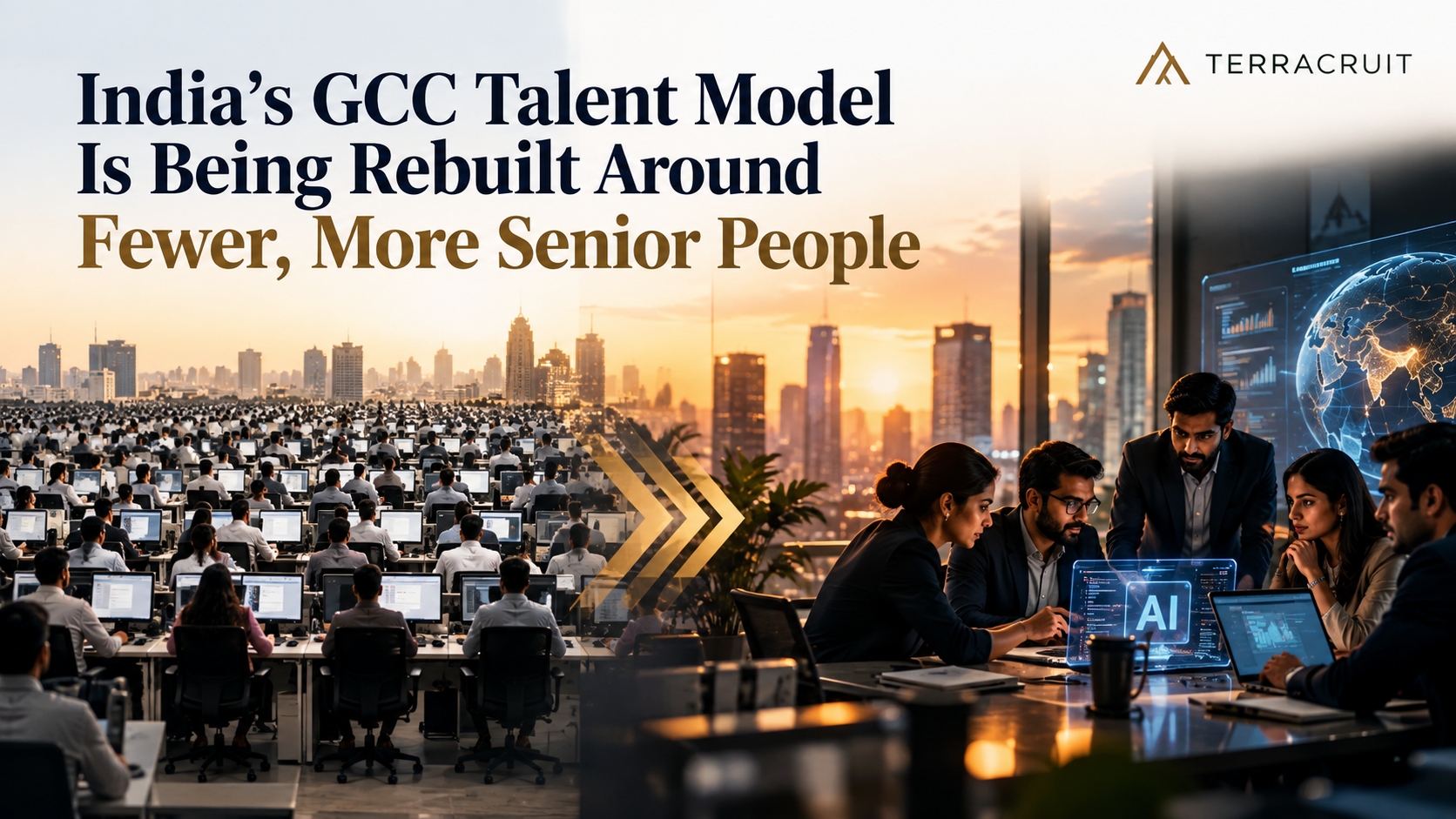
India’s GCC market is continuing to grow, but the traditional hiring model is changing. Recent GCC research shows stronger demand for AI, engineering, cloud and product capabilities, alongside a rising preference for experienced professionals over large volumes of entry-level talent. The implication for global companies is straightforward: the question is no longer simply how many people an India GCC can hire, but how much capability each person can bring to the operating model.
Key Takeaways
- India’s GCC hiring is still expanding, with GCC hiring projected at more than 510,000 jobs in 2026 according to foundit data reported by ETHRWorld.
- ANSR’s September 2026 research found GCC hiring grew approximately 12–15% year over year in H1 2026.
- Nearly 65% of newly created GCC roles analysed by ANSR required AI skills, while AI and data hiring increased approximately 45% year over year.
- The experience curve is moving upward: professionals with 4–6 years of experience represented 34% of GCC hiring in 2025–26, compared with 26% previously.
- The share of 0–3-year professionals declined from 42% to 30% over the same period.
- Zinnov’s 2026 GCC research reports an average salary increase of 9.8%, but 21.1% for AI/ML talent, illustrating how differentiated the market has become.
- India’s GCC ecosystem now spans more than 2,100 centres and approximately 2.36 million professionals, according to the FY2026 Zinnov-Nasscom landscape.
- For international companies, workforce design is becoming as important as recruitment volume.
The GCC Growth Story Has Entered a Different Phase
India's GCC story is often told as a story of expansion.
That remains true.
The FY2026 Zinnov-Nasscom GCC landscape identifies 2,117 GCCs across 3,728 units in India, employing approximately 2.36 million professionals and generating $98.4 billion in revenue. The ecosystem has grown 32% since FY2021.
But the more important change is happening underneath those headline numbers.
GCCs are increasingly being asked to perform higher-value work: product development, engineering, artificial intelligence, cybersecurity, analytics, research and global business functions.
That changes the economics of hiring.
A centre designed around repetitive execution can optimise for headcount.
A centre responsible for AI architecture, product ownership or global engineering outcomes has to optimise for capability density.
That distinction is becoming central to India's next GCC cycle.
From the Workforce Pyramid to the Capability Diamond
The traditional offshore workforce model was broadly pyramidal:
- Large numbers of junior employees
- A smaller middle-management layer
- A relatively small group of senior specialists and leaders
AI is putting pressure on that structure.
ANSR's September 2026 research describes an emerging model in which GCC teams are smaller, more experienced and increasingly AI-enabled. Its analysis of more than 5,000 live openings and more than 20,000 hiring patterns found that nearly two-thirds of new roles required AI skills.
The result is not necessarily fewer jobs.
It is a different composition of jobs.
Consider the distinction:
| Traditional GCC model | Emerging GCC model |
|---|---|
| Large delivery teams | Smaller specialist teams |
| Junior-heavy workforce | Greater mid-career concentration |
| Process execution | Problem ownership |
| Functional specialists | Cross-functional specialists |
| Human-only workflows | AI-assisted workflows |
| Headcount optimisation | Capability-density optimisation |
| Centralised major hubs | Increasing interest in distributed hubs |
| Training after hiring | Skills requirements defined before hiring |
This is why simply projecting historical headcount growth forward can produce misleading workforce plans.
Why Mid-Career Talent Is Becoming More Valuable
One of the clearest signals is the changing experience profile.
According to foundit data reported by ETHRWorld, professionals with 4–6 years of experience accounted for 34% of GCC hiring in 2025–26, up from 26% previously.
Meanwhile, the proportion of professionals with 0–3 years of experience declined from 42% to 30%.
There is a straightforward economic explanation.
An experienced engineer, product manager or data professional can often operate with considerably less supervision. When AI tools automate portions of execution, the value of the person increasingly lies in knowing:
- What problem should be solved?
- Which output is reliable?
- Which architecture is appropriate?
- Where should human judgment override an automated result?
- How should the work connect to the broader business?
The scarce capability therefore shifts upward.
It is not simply about knowing how to use AI.
It is about knowing where AI should be used.
AI Is Creating a Two-Speed Talent Market
The most important implication for GCC leaders may be that there is no longer one Indian technology talent market.
There are increasingly several.
Zinnov's 2026 research reports an average GCC salary increase of 9.8%, but puts the figure at 21.1% for AI/ML talent and 20% for cybersecurity talent. It also estimates a 51% gap between AI talent demand and supply.
This produces an uncomfortable contradiction.
A company can simultaneously experience:
- Stable compensation for conventional roles
- Strong competition for AI specialists
- Automation-driven restructuring of routine roles
- Elevated retention risk among high performers
- Increasing demand for senior technical leadership
Treating these as one workforce problem is therefore likely to result in poor planning.
The compensation architecture, sourcing strategy and retention model need to reflect the differences between these talent pools.
The Cost Advantage Is Not Disappearing. It Is Changing.
There is a tendency to frame AI-driven GCC hiring as a threat to India's labour-cost advantage.
That is too simplistic.
India's advantage was never only about low salaries.
The country's deeper proposition combines:
Talent scale + technical depth + English proficiency + engineering capability + ecosystem maturity + cost competitiveness.
The Economic Survey has previously highlighted India's large STEM and software-engineering talent base and the movement of GCCs toward higher-value engineering and product functions.
What is changing is the unit of comparison.
The relevant question for a global company is increasingly not:
"How much does an Indian engineer cost?"
It is:
"What level of global output can an India-based engineer produce when equipped with AI, strong management and the right operating model?"
That is a much more strategic calculation.
The New GCC Hiring Problem: Capability Density
This creates a new metric for companies building teams in India.
Capability density
Capability density can be thought of as the amount of business-critical capability embedded in each unit of workforce.
A high-density team might contain:
- AI engineers
- Product managers
- Solution architects
- Data scientists
- Cybersecurity specialists
- Domain experts
- Engineering leaders
A lower-density team might contain significantly more employees performing narrower, repetitive tasks.
The second team may be larger.
The first team may create substantially more strategic value.
This distinction matters because GCCs are increasingly being asked to own outcomes rather than simply execute instructions.
The FY2026 Zinnov-Nasscom research describes this broader evolution as a movement from delivery engines toward enterprise-level capability centres.
What This Means for Companies Building a GCC in India
For a company considering its first India GCC, or expanding an existing one, the hiring sequence deserves reconsideration.
1. Define the capability before defining the headcount
Instead of starting with:
"We need 500 employees."
Start with:
"What global capability must India own?"
For example:
- AI product engineering
- Cybersecurity
- Data platforms
- Finance transformation
- Clinical operations
- Supply-chain analytics
- Product management
- Engineering R&D
The talent model should follow the capability.
2. Build the senior spine first
A GCC cannot become strategically important simply because it has thousands of employees.
The leadership and specialist layer determines what the centre can actually own.
Early hiring should therefore identify the people capable of establishing:
- Architecture
- Product ownership
- Engineering standards
- Governance
- Domain expertise
- Global stakeholder relationships
The junior workforce can then scale around that spine.
3. Stop treating AI as a separate department
The emerging model suggests that AI competency increasingly needs to be embedded across functions.
An engineering team that does not understand AI-assisted development may become less productive.
A finance team that cannot work with automation may remain operationally expensive.
A product team without AI fluency may struggle to compete with faster development cycles.
AI therefore becomes part of the workforce architecture rather than simply another hiring category.
4. Consider Tier-II locations as part of the operating model
India's GCC geography is also beginning to broaden.
The FY2026 Zinnov-Nasscom research identifies emerging cities alongside established hubs, while recent research highlights cities such as Coimbatore, Ahmedabad and Kochi as increasingly credible alternatives for specialised GCC work.
The decision should not be framed simply as:
Bengaluru vs. cheaper city.
It should instead consider:
- Skill availability
- Talent depth
- Attrition
- Compensation
- Infrastructure
- Leadership availability
- University ecosystem
- Hiring velocity
- Long-term scalability
Location is becoming part of workforce design.
What This Means for Indian Talent
The shift has an equally important consequence for candidates.
The market is becoming less degree-centric and more capability-centric.
Professionals who want to remain competitive in international GCCs should increasingly build combinations of:
Domain expertise + technology fluency + AI capability + communication + business understanding.
For example:
A software engineer who understands an industry problem can be more valuable than a developer who only understands a programming language.
A finance professional who can redesign processes using automation may have a stronger trajectory than one whose work remains entirely manual.
A healthcare professional who combines domain credentials with digital-health expertise may access opportunities that a conventional profile cannot.
The broader lesson is that specialisation is becoming more valuable when combined with technological adaptability.
The Bigger Strategic Shift
The real story is therefore not that AI is replacing GCC workers.
It is that AI is changing what global companies expect an India-based workforce to accomplish.
India's GCC ecosystem has already moved substantially beyond the back-office model.
The next transition is from:
Scale → Capability
Execution → Ownership
Headcount → Productivity
Junior-heavy teams → Experienced specialists
Cost arbitrage → Capability arbitrage
That last transition is particularly important.
India's long-term GCC advantage may increasingly depend not on having the cheapest workforce, but on having one of the world's deepest pools of professionals capable of combining domain knowledge, engineering and AI-enabled execution.
What Global Hiring Leaders Should Do Now
For companies planning India hiring in 2026–27, five actions deserve attention:
- Rebuild workforce plans around capabilities rather than job counts.
- Benchmark specialist compensation separately from general salary budgets.
- Identify the roles where AI changes productivity before deciding hiring volumes.
- Create a deliberate senior-talent acquisition strategy instead of relying exclusively on campus or volume hiring.
- Evaluate Tier-II locations where talent availability and retention economics justify a distributed model.
The companies that get this right will not necessarily have the largest India teams.
They may have the most capable ones.
Frequently Asked Questions
Is GCC hiring in India still growing in 2026?
Yes. ANSR reported approximately 12–15% year-over-year GCC hiring growth in the first half of 2026, while foundit data reported by ETHRWorld projects GCC hiring of approximately 510,452 jobs for the full year.
Are Indian GCCs hiring fewer people because of AI?
The evidence points more clearly to a change in workforce composition than to a simple reduction in hiring. GCC hiring continues to grow, while routine work is being automated and demand is shifting toward specialised and experienced professionals.
Which skills are most in demand in Indian GCCs?
AI, data, engineering, cloud, cybersecurity and product capabilities are among the areas seeing strong demand. ANSR reported that nearly 65% of new GCC roles in its 2026 analysis required AI skills.
Why are GCCs hiring more mid-career professionals?
Experienced professionals can take greater ownership of complex technical and business problems with less supervision. Current hiring data shows a larger share of GCC recruitment moving toward the 4–6-year experience bracket.
Is India still attractive for GCC expansion?
India remains a major global GCC location. The FY2026 Zinnov-Nasscom landscape records 2,117 GCCs, 3,728 GCC units and approximately 2.36 million professionals in the ecosystem.
Are Tier-II Indian cities becoming viable GCC locations?
Yes. Recent GCC research increasingly identifies cities beyond the traditional major hubs as potential locations for specialised operations. The attractiveness of each city depends on talent depth, infrastructure, compensation, retention and scalability rather than cost alone.
What is the biggest change in GCC hiring?
The central change is the move from volume-oriented workforce expansion toward capability-oriented hiring. Companies are increasingly looking for people who can combine specialist expertise, business judgment and AI-enabled execution.
What should companies consider before building an India GCC?
Companies should first define the capabilities they want India to own, then determine the required leadership, specialist and execution layers. Location, compensation, talent availability, governance and scalability should be designed around that capability strategy.
Final Thoughts
India's GCC story is entering a more sophisticated phase.
The first era was about proving that global companies could operate effectively from India.
The second was about scaling.
The emerging third era is about who can create the most value per employee.
That changes everything from location strategy and compensation to recruitment, leadership development and workforce planning.
For global companies, the opportunity is not simply to build a larger team in India.
It is to build a team that can own more of the global enterprise.
About Terracruit
Terracruit helps organisations navigate India's evolving talent ecosystem—from specialist hiring and global talent access to GCC workforce strategy and cross-border talent requirements.
Our focus is on connecting global businesses with the capabilities they need to build and scale in India.
Sources
- Zinnov & Nasscom, The GCC Value Orbit — GCC Landscape in India 2026.
- ANSR, Talent Trends in GCCs in India 2026.
- ETHRWorld / Economic Times HR, GCC hiring and experience-mix data based on foundit.
- Zinnov, Salary Increase, Attrition & Hiring Trends in GCCs 2026.
- Government of India, Economic Survey, GCC ecosystem analysis.
- Government of India / PIB, services exports and GCC ecosystem analysis.
- EY India, How Coimbatore can build its path to 200 GCCs by 2032.
Planning your career abroad?
Terracruit walks you through every step — persona mapping, CV and LOR reviews, outreach and interview preparation — so you are never figuring it out alone. Start with our free tools and see where you stand.
Or talk to us: Contact Terracruit